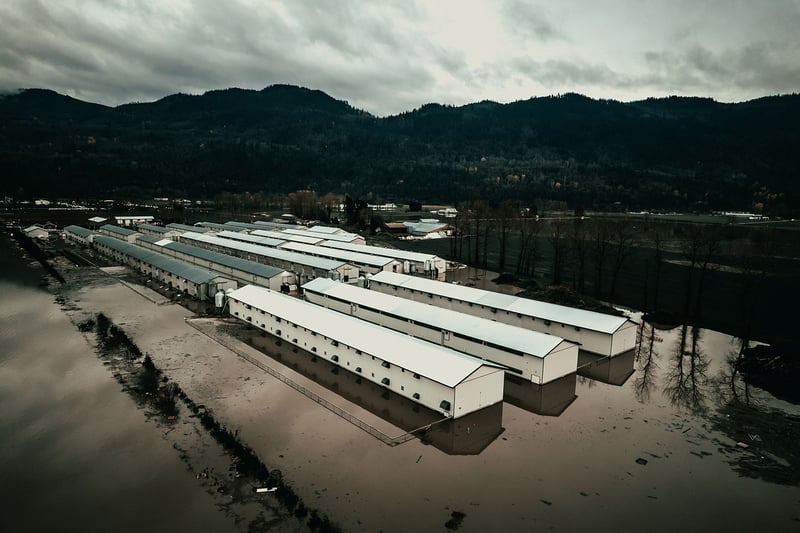
Abbotsford’s floods reveal a system that fails animals, again
Blog
Four years later, another devastating flood in Abbotsford highlights a critical gap: farmed animals are largely excluded from climate resistance and disaster planning.
In December 2025, four years after the devastating floods of November 2021, Abbotsford flooded again.
As heavy rains overwhelmed British Columbia’s Fraser Valley, evacuation orders were issued, roads disappeared underwater and farms were once more inundated. For farmed animals trapped inside barns, this was not just another emergency – it was a repeat of a tragedy we already knew how to prevent.
In 2021, an atmospheric river submerged farms across Abbotsford’s Sumas Prairie, one of the province’s most intensive agricultural regions. Hundreds of cows, tens of thousands of pigs and more than 600,000 chickens and turkeys drowned in the floodwaters. In the latest flood, poultry farms were hit the hardest, with more than 175,000 birds reported dead.
These were not freak events. They were the predictable outcome of a system that confines tens of thousands of animals in crowded buildings, with no realistic way to evacuate them when disaster strikes.
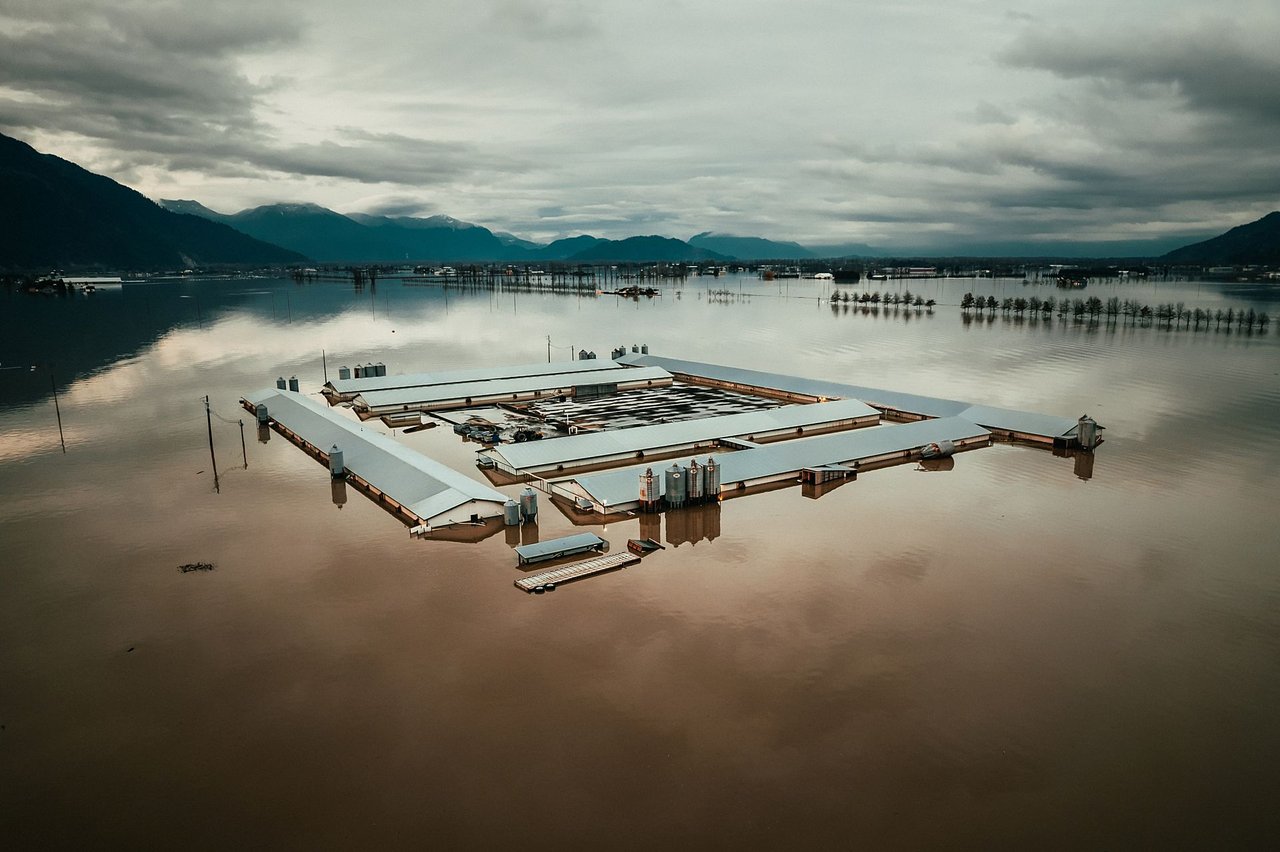
Why disaster plans fail animals
After the 2021 floods, World Animal Protection commissioned research into how climate disasters affect farmed animals and why existing disaster plans fail when they are needed most.
Following the report’s release, we have engaged small-scale farmers, partners and policymakers around the findings of the report, using it as a tool to spark dialogue on climate resilience, emergency planning and the future of farmed animal protection in Canada.
The findings were clear: disaster management guidelines do not account for the scale of industrial farming. Evacuating thousands of animals requires time, transport, labour and safe destination – none of which exist during a fast-moving flood. As a result, animals are often “sheltered in place,” a phrase that can mean drowning, suffocation, heat stress or untreated injuries.
In short, the system itself creates the risk.
At the same time, small-scale farmers who are investing in more resilient and higher welfare farming practices are not financially rewarded for their proactive practices in adapting to climate change and are not always able to receive disaster relief for their losses.
As extreme weather events become more frequent and severe as the climate changes, rebuilding the same systems with the same vulnerabilities all but guarantees that animals will suffer again when the next disaster hits.
What must change
If we are serious about protecting animals, we must move beyond emergency response and address the root causes of this suffering.
That means reducing reliance on factory farming, which is a significant driver of the climate crisis.
We recommend the Federal Government:
- Mandate that animals be included in disaster preparedness, response and risk reduction strategies.
- Support the development of community-first responder models through funding equipment and providing the legal authority to respond.
- Support farmers in adapting to climate change and transitioning away from intensive farming practice.
- Require farmers to meet conditions for building back better to receive disaster relief.
- Reward farmers who use high-welfare, resilient and sustainable farming practices (for example, regenerative and agroecological farming practices).
The choice is clear: continue accepting animal suffering as inevitable or change the systems that make it so.
Farmers are on the front lines of the climate crisis and need more support in adapting to increasingly more frequent and severe climate emergencies. But we can no longer ignore that factory farming is a significant contributor of the climate crisis. It is a system that leaves animals more vulnerable to suffer and die a slow agonizing death in floods, heat waves, forest fires and other climate emergencies.
Farmed animals should not be collateral damage of predictable climate disasters.
We knew this would happen. Now, we must act to prevent it from happening again.
What can you do?
Ask your Member of Parliament (MP) to advocate for federal funding to help farmers to adapt to climate change by transitioning away from factory farming and towards more humane, sustainable and resilient practices. (Find your MP and their contact info here!)
Banner photo: Aerial view of a large chicken farm sitting partially submerged in the flood waters in Abbotsford, BC, 2021. (Nick Schafer Media / We Animals)