What's feeding factory farming?
Blog
What does it take to feed billions of farmed animals? The answer involves vast crop production, growing environmental pressures and serious consequences for natural resources, wildlife and global food security.
When we think about the environmental and animal welfare impacts of producing meat, dairy and eggs, we don't always consider what goes into feeding the animals behind these products. Yet, animal feed production is a massive global industry. From soy plantations in South America to fishmeal production in the oceans, feeding billions of farmed animals requires enormous amounts of crops, land and natural resources. Factory farming depends on this global supply chain, but its impacts reach far beyond the farm.
What is animal feed?
Animal feed refers to the crops, grains and other ingredients used to nourish farmed animals. Common ingredients include soy, maize, cereals and fishmeal, which provide the protein and energy needed for animals to grow and develop.
Industrial farming relies heavily on specialized diets to support animals bred for rapid growth and high productivity which sometimes wreak havoc on the animals’ digestive or metabolic systems.
Three important ingredients drive much of the global animal feed trade:
- Soy: A major source of protein in livestock feed. Around 75-80% of global soy production is used to feed livestock.
- Maize: Also known as dried, corn kernels. One of the world's most widely produced cereal crops and an important energy source in animal diets.
- Fishmeal: Made from processed fish and often used in aquaculture and feed ingredients for livestock and poultry.
The wider impacts of animal feed production
Around 80% of global agricultural land is used for livestock production, including grazing and growing crops for animal feed. This demand heavily contributes to deforestation and habitat destruction, particularly in ecologically important regions such as the Amazon.
These environmental impacts are felt closer to home, too. In 2020, producing 28.1 million tonnes of livestock feed in Canada generated approximately 8.38 million tonnes of greenhouse gas emissions. This accounted for 11% of the country's total agricultural emissions, according to research from Stand.Earth commissioned by World Animal Protection.
There is also a food security concern. Growing crops to feed animals means diverting resources away from direct human consumption. For example, around 35% of the world's cereal supply was used as animal feed in 2023 and for every 100 calories of cereals fed to farmed animals, only around 17–30 calories enter the human food supply as meat, eggs or dairy.
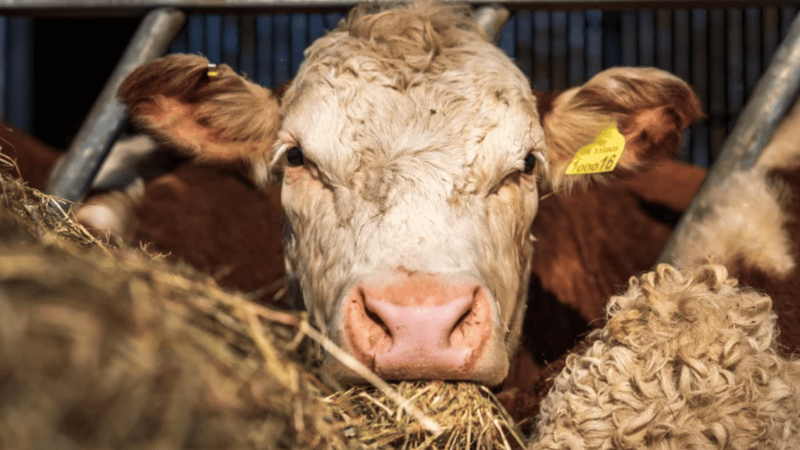
Furthermore, feeding animals for maximum output can cause serious health and welfare problems, such as beef cows fed high grain diets once they are transferred from pasture to feedlot. As ruminant animals, high corn and grain diets which lack the roughage and fiber the animals need, can cause severe digestive upset, liver abscesses, acidosis and lameness.
Can animal feed ever be sustainable?
Some companies promote deforestation-free soy and sustainability certifications as ways to reduce the environmental impact of animal feed. While better sourcing practices can help address certain issues, they don't tackle the scale of the problem. For example, cattle raised in small-scale, pasture-based systems can graze on grass and other vegetation rather than relying on large quantities of soy-based feed.
A truly sustainable food system requires more than changing where animal feed comes from. It means reducing reliance on industrial animal agriculture, shifting towards more plant-based diets and supporting higher-welfare farming systems that make better use of local resources.
You have the power to put an end to factory farming!
Sign the petition to stop factory farm development in Canada and help give animals a chance to live the content and natural lives they deserve.