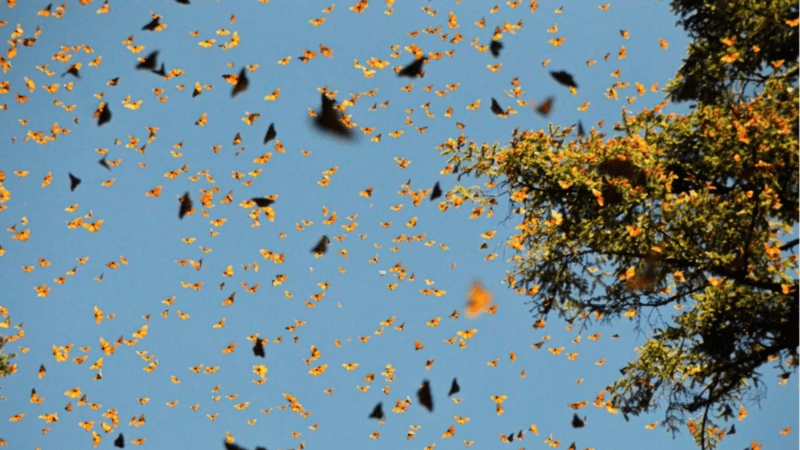
Every November, millions of monarch butterflies arrive in Mexico after travelling thousands of kilometres across North America. New technology is helping scientists understand how to track and protect these vital pollinators.
During fall, the mountain forests of central Mexico become home to millions of monarch butterflies. After travelling thousands of kilometres from Canada and the United States, these delicate insects gather in enormous clusters on trees to escape the colder months.
Their arrival is one of nature's wildest events. But despite decades of research, scientists are still uncovering how monarchs navigate such enormous distances, where they stop along the way and what they need to survive. Emerging tracking technology is offering a rare glimpse into this phenomenon.
The incredible journey from Canada to Mexico
Between the months of September through October, monarch butterflies from eastern Canada, including Ontario and Quebec, begin their 3,800 kilometer southward migration to reach their wintering grounds in Mexico.
Unlike many migrating animals, monarchs don't complete the entire journey within one generation. Instead, their migration is a multi-generational cycle:
- Spring (March-April): Monarchs leave Mexico, travel north into Texas and lay eggs on milkweed before dying.
- Summer (May-July): Successive generations move through the Midwest, reaching the Great Lakes, Ontario, Quebec and the Atlantic provinces.
- Fall (Late August-November): A long-lived generation travels south from the Great Lakes, covering up to 4,500 kilometers through the central United States towards Mexico.
- Winter (November-March): Monarchs gather in large colonies in Mexico's mountain forests, clustering in trees until spring.
How science is uncovering the secrets of their migration
New technology is helping scientists uncover the secrets of monarch migration. In fall of 2026, researchers began using tiny, solar-powered radio transmitters, developed by Cellular Tracking Technologies, to follow butterflies across North America.
The devices weigh roughly as much as a drop of water, but not every butterfly is suitable for tracking. Researchers generally select monarchs weighing more than 400 milligrams to avoid placing too much weight on smaller individuals.
Nearly 1,750 monarchs were tagged during the 2026 research season, with around 175 already detected in Mexico!
Protecting monarch populations
Understanding where monarchs travel and rest can help conservationists identify habitats that need protection, and this research comes at a critical time. Since the 1990's, eastern monarch populations have declined by more than 80%, while western populations have fallen by approximately 95%.
Habitat destruction, pesticide exposure and climate change all threaten their survival. Warmer temperatures can disrupt migration timing, while drought reduces the availability of nectar-producing flowers.
Tracking technology offers a new way to understand these challenges. However, protecting monarchs also requires action on the ground. Planting native milkweed, growing pollinator-friendly flowers, reducing pesticide use and preserving natural habitats can all help support their populations. But why is this so important?
The link between pollinator protection and agroecology
This remarkable migration highlights the importance of shifting towards more eco-oriented agriculture. By embracing agroecological practices that work with nature, farmers can help protect monarchs and other pollinators that support biodiversity, contribute to plant reproduction and sustain healthy ecosystems.
Our work to support this transition recognizes that how we grow our food has a direct impact on wildlife and the habitats they depend on. Moving towards more sustainable, biodiversity-friendly farming is essential to creating agricultural landscapes where both nature and food systems can thrive for generations to come.
Join a community of people creating a kinder world for animals and nature!
Subscribe to our newsletter to learn more about wildlife, take meaningful action and stay inspired by stories of positive change from across Canada.